





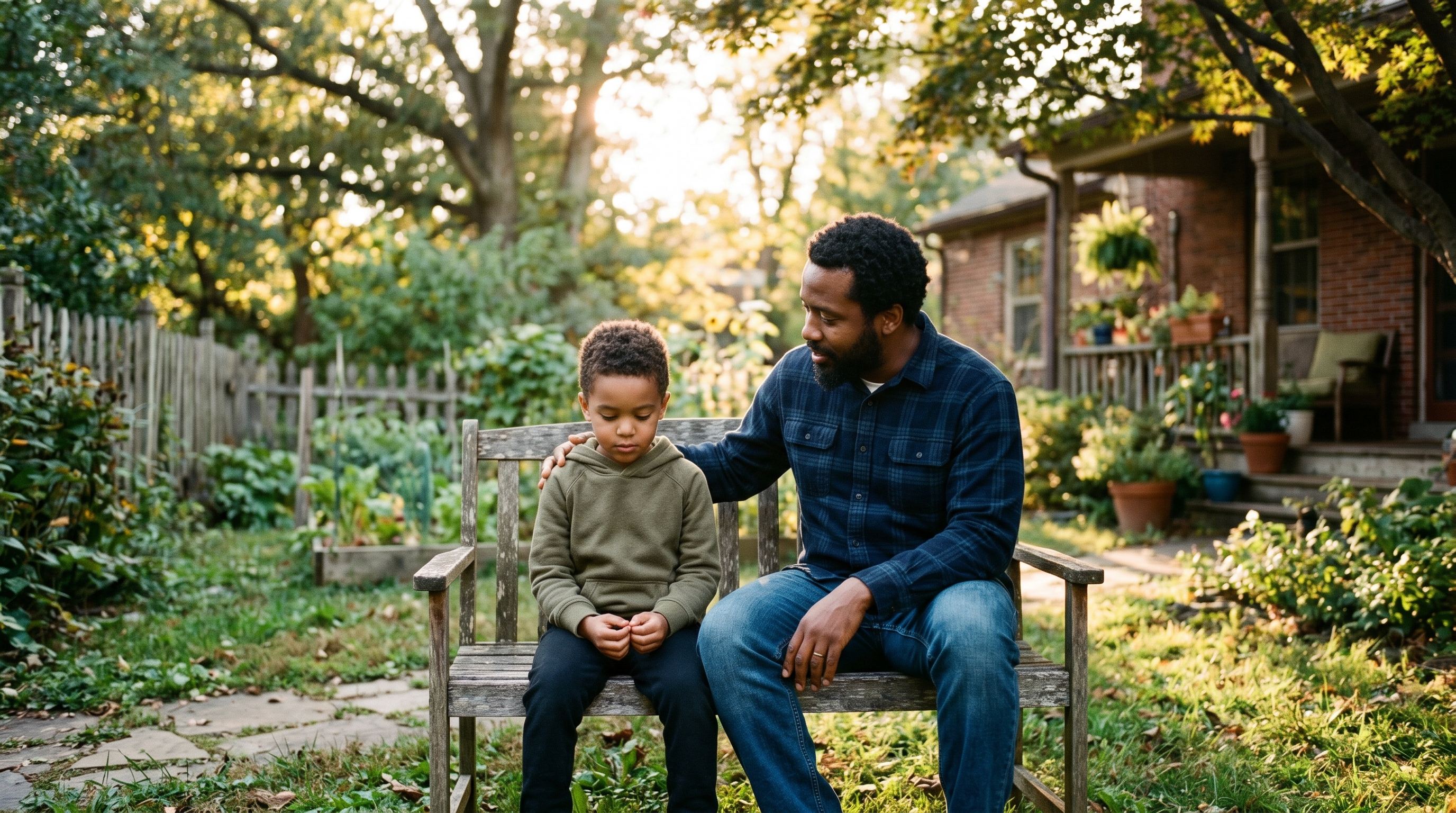
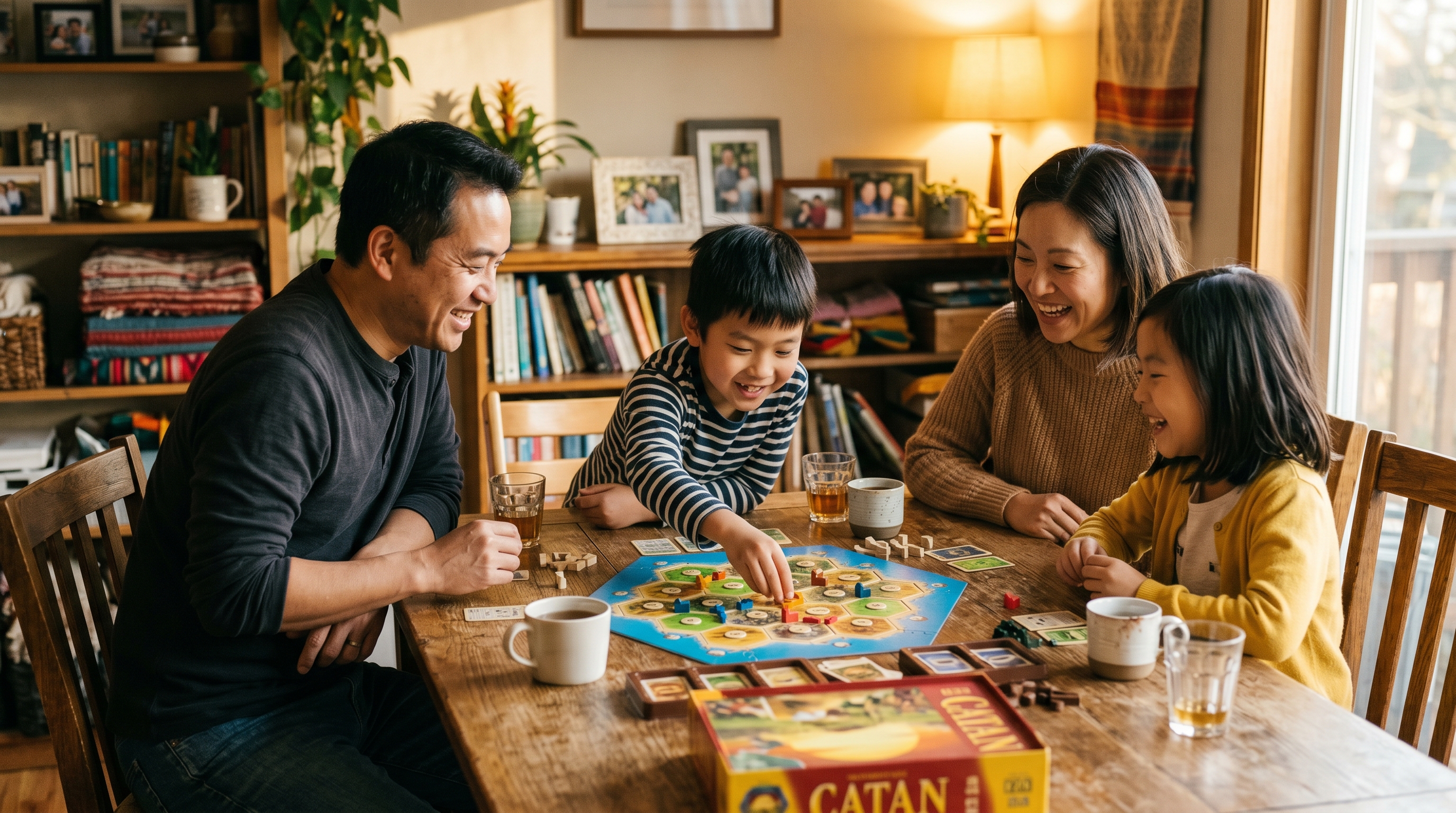
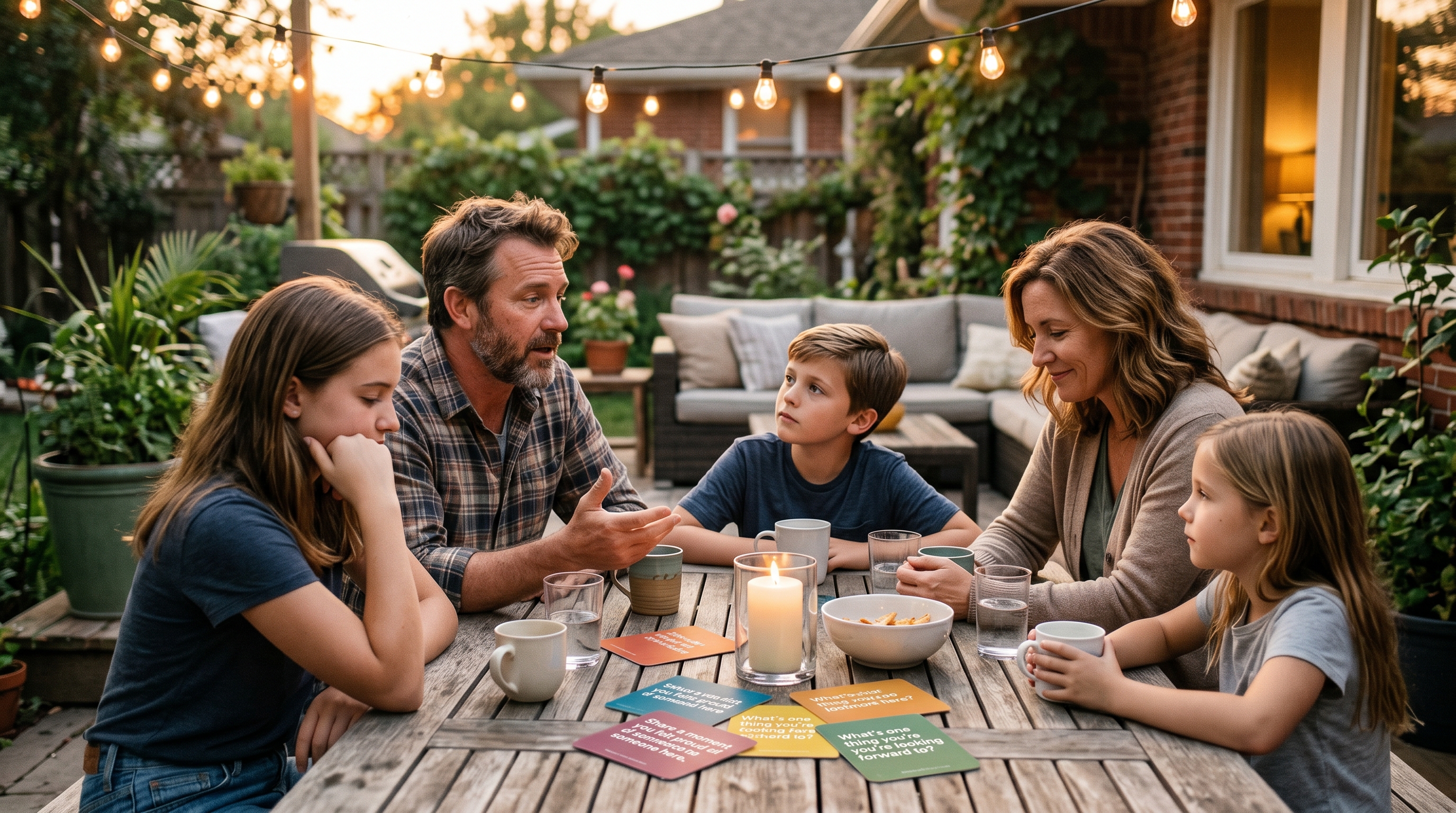
Parent and child having a conversation
For parents raising communicators · Ages 5–14

Better questions.
Deeper conversations.

Research-backed conversation starters, family activities, and communication tools — designed for the dinner table, the car ride, and the quiet moment before bed.

Free · 100 conversation starters · Instant delivery · No spam

12K+
families using the cards
100
free conversation starters
Ages 5–14
all age-appropriate
12K+
families using the cards
100
free conversation starters
5
cornerstone guides
Ages 5–14
age-appropriate content
Premium Resource

The Family Connection Toolkit — $14.97

30 conversation cards, 20 family activities, 10 communication exercises, a 4-week implementation guide, and 4 printable worksheets. The natural next step after the free cards.

📦
Free Resources

Start Here

Five research-backed guides covering the conversations that matter most. All completely free.

💬
Communication

100 Conversation Starters for Kids

Move beyond "how was school?" with questions that open real conversations — organised by age group.

Read free guide →
Confidence

Helping Shy Children Build Confidence

Research-backed strategies for nurturing the quiet child's voice without pushing them past their comfort zone.

Read free guide →
📵
Screen-Free

50 Screen-Free Family Activities

Unplugged activities chosen specifically because they spark conversation and genuine family connection.

Read free guide →
❤️
Emotional Intelligence

EQ Games for Kids

30 games that teach children to identify and regulate their emotions while they think they're just playing.

Read free guide →
🏠
Family Connection

Family Discussion Questions

50 meaningful questions for the whole family, organised by topic — memories, values, gratitude, and more.

Read free guide →
🃏

Free Download

100 Family Conversation Cards — print them, cut them, keep them on your dinner table.

How It Works

Simple by Design

No programs to complete. No courses to follow. Just practical tools that fit inside real family life.

01
🃏

Download the free cards

100 conversation starters organised by age. Enter your email and they arrive instantly.

02
🍽️

Try one at dinner tonight

Pick one card. Ask it. Go first with your own answer. Wait. See what happens.

03
📦

Go deeper with the toolkit

When you're ready, the Family Connection Toolkit gives you 30 cards, 20 activities, and a full 4-week guide — $14.97.

What Parents Say

It Changes Dinner

★★★★★

"We used card #14 at dinner and my 7-year-old told us about a friendship problem she'd been carrying for weeks. I had no idea. These questions open doors."

Sarah M.
Sarah M., mum of two
★★★★★

"Card #63 started a 45-minute conversation with my 13-year-old who's been almost impossible to reach. I'll never forget it."

David L.
David L., dad of three
★★★★★

"I keep them in a little jar on the kitchen table. My kids actually ask to use them. That says everything."

Priya K.
Priya K., mum of three
About

Every child has something
important to say.

ExpressiveChild exists to give parents the tools to hear it. We build conversation starters, family activities, and communication resources grounded in research — and designed for the realities of family life.

Parent and child reading together
The Problem We Exist to Solve

Most family conversations stay on the surface. You ask how school was. They say fine. The moment disappears. It isn't that your child doesn't want to talk — it's that vague questions produce vague answers.

Specific, genuine, age-appropriate questions open doors that standard check-ins never reach. We spent a long time figuring out which questions those are, how to organise them, and how to make them easy to use in real family life.

Our Core Beliefs

Connection happens in small moments.

Not on vacation. Not in big planned conversations. In the car. At dinner. Before bed. We design tools for those ordinary moments.

Age-appropriate means something specific.

A question that opens up a 7-year-old will shut down a 13-year-old. Everything we make is calibrated to what children can genuinely engage with at each stage.

Research guides our choices.

Our resources draw from decades of research in child development, family communication, attachment theory, and emotional intelligence. We make that research usable.

Simplicity is a feature.

The best family communication tool is the one you actually use. We prioritise practical over comprehensive, and usable over impressive.

Consistency beats intensity.

Five minutes every day builds stronger relationships than one deep conversation a week. We design for the long game, not the single session.

Start with the free cards

100 conversation starters organised by age — for the dinner table, the car ride, and the quiet moment before bed.

📦
The Family Connection Toolkit
30 cards + 20 activities + 10 exercises + 4-week guide · $14.97
Free Resources

Everything we've made,
completely free.

Five cornerstone guides covering the conversations that matter most. Start anywhere.

💬
Communication

100 Conversation Starters for Kids

Move beyond "how was school?" — organised by age, with tips on how to use them.

Read Free →
Confidence Building

Helping Shy Children Build Confidence

Research-backed strategies for nurturing the quiet child's voice.

Read Free →
📵
Screen-Free Activities

50 Screen-Free Family Activities

Unplugged activities that spark real conversation and genuine connection.

Read Free →
❤️
Emotional Intelligence

Emotional Intelligence Games for Kids

30 games that build EQ while children think they're just playing.

Read Free →
🏠
Family Connection

Family Discussion Questions That Build Connection

50 meaningful questions organised by topic — memories, values, gratitude, and more.

Read Free →
Weekly Tips

Get new resources

One new conversation tip, activity idea, or resource — every week, completely free.

Digital Downloads

Everything is instant and printable.

Download immediately after purchase. Print as many copies as your family needs. No subscription, no expiry.

⭐ Our Best Product

The Family Connection Toolkit

30 conversation cards, 20 activities, 10 exercises, a 4-week guide, and 4 printable worksheets. The complete system.

30 Cards 20 Activities 10 Exercises 4-Week Guide 4 Worksheets
Was $29.97
📦

All Products

💬
Conversation Cards

Conversation Cards: Ages 5–8

50 illustrated conversation cards — feelings, imagination, family, and big ideas.

💬
Conversation Cards

Conversation Cards: Ages 9–14

60 thought-provoking cards for tweens covering opinions, identity, and values.

🌿
Workbook

Feelings & Emotions Workbook

48-page guided workbook helping children identify and manage their emotions.

📖
Journal

My Story Journal: Ages 8–12

A structured creative journal guiding children through building their own stories.

🎯
Activity Kit

Confidence Builder: 30-Day Kit

30 days of activities to build self-expression and speaking skills.

🏠
Printable Pack

Family Connection Ritual Cards

36 cards for establishing weekly rituals that build lasting communication habits.

🤝
Activity Kit

Social Skills Practice Pack

Role-play scenarios to help children navigate friendships with confidence.

📵
Activity Kit

Screen-Free Weekend Bundle

20 structured activities for connection-focused screen-free family weekends.

📥
Instant Download
Available immediately
🖨️
Print at Home
Unlimited copies
🔒
Secure Checkout
Safe & encrypted
Keep Forever
No subscription
Blog

Guides, strategies,
and real talk for parents.

Featured · Communication

100 Conversation Starters for Kids — Organised by Age

Move beyond "how was school?" with questions that actually open doors. Organised by age group, with tips on how to ask them.

Read free guide → 11 min read
Confidence Building

Helping Shy Children Build Confidence

Research-backed strategies for nurturing the quiet child's voice without pushing them past their comfort zone.

Read → 14 min
Screen-Free Activities

50 Screen-Free Family Activities That Build Communication

Unplugged activities chosen specifically because they spark conversation and genuine family connection.

Read → 13 min
Emotional Intelligence

Emotional Intelligence Games for Kids: 30 Activities

30 games that teach children to identify and regulate their emotions while they think they're just playing.

Read → 16 min
Family Connection

Family Discussion Questions That Build Real Connection

50 meaningful questions organised by topic — memories, values, gratitude, and honest conversations.

Read → 12 min
Contact

Say hello.

Have a question about a product, a download issue, or just want to share a win your kid had? We read every message.

Or email us directly: hello@expressivechild.com

100 Conversation Starters for Kids
💬 Communication

100 Conversation Starters for Kids

⏱ 11 min read👶 Ages 5–14
scroll
⚡ Quick Answer

Children say "fine" because "how was school?" is too vague to trigger a specific memory. These 100 questions are designed to be concrete, age-appropriate, and genuinely interesting — so your child actually wants to answer.

Every evening, millions of parents ask the same question. Every evening, millions of children give the same answer. The problem isn't your child's willingness to talk — it's that the question doesn't give them anything specific to grab onto. What follows are 100 alternatives, organised by age, that actually work.

Ages 5–7: Anchor to Sensory Moments

Ages 5–7

Young children live in the concrete and sensory. Their memories are best accessed through specific objects, people, and feelings rather than abstract concepts like "your day."

1
What made you laugh today?

Laughter is a vivid, easy-to-retrieve memory anchor for young children.

2
What did you eat for lunch? Did you like it?

Mundane specifics unlock broader conversation about the day.

3
Did anything surprise you today?

Surprises are emotionally tagged and therefore easy to remember.

4
Who sat next to you today?

Social context opens social conversation naturally.

5
What was the most fun part of recess?

Recess is unstructured and memorable — a rich source of stories.

Continue with these for ages 5–7:

  • Did your teacher say anything that you remember?
  • Was there anything today that felt hard or confusing?
  • Tell me about something you drew or made.
  • Did you help anyone today? Did anyone help you?
  • What would you change about today if you could?
  • What game did you play? Can you show me how to play it?
  • What's something you learned today that I don't know?
  • Did anything feel scary or weird today?
  • If your day was a colour, what colour would it be?
  • What was the kindest thing someone did today?
  • Did you see anything funny on the way to school?
  • What's the best thing about your classroom?
  • If you could bring one toy to school tomorrow, what would it be?
  • Did you feel proud of yourself today? About what?
  • What's one thing you're hoping happens tomorrow?
Free Download

100 Family Conversation Cards

All 100 of these questions — plus 50 more for family discussions — formatted as beautiful printable cards. Free, instant download.

🃏

Ages 8–10: Invite Opinions and Observation

Ages 8–10

Children in middle childhood are developing sophisticated views about fairness, friendship, and how the world works. Questions that invite perspective and judgment unlock richer conversation.

1
What was the most interesting thing that happened today?

Invites subjective evaluation rather than factual recall.

2
Was there a moment today where you weren't sure what to do?

Opens conversation about decision-making and social navigation.

3
Did anything happen today that seemed unfair?

Children this age have a strong sense of justice — this resonates deeply.

4
What's something you understand now that you didn't this morning?

Focuses on growth and learning rather than just reporting events.

5
If you could change one rule at school, what would it be and why?

Invites systems thinking and opinion expression.

  • Who made you laugh the most today?
  • What's a question you thought of today that you didn't get to ask?
  • Did you notice anyone being really kind or really unkind?
  • If today were a book, what would the title be?
  • What would you want your best friend to know about today?
  • What's the most important thing you have to do tomorrow?
  • Did you disagree with anyone today? What happened?
  • What's something that made you feel proud — even a little?
  • If you could rewind and redo one moment from today, what would it be?
  • Who is someone you'd like to get to know better?
  • What's a problem you're trying to figure out?
  • Did anything happen today that you're still thinking about?
  • What did you do today that required real effort?
  • Is there anything you wish you'd said — or hadn't said?
  • What are you looking forward to about tomorrow?
  • What's the funniest thing anyone said today?
  • Was there a moment where you felt really good at something?
  • What would your teacher say was your best moment today?
  • Did you learn anything today that changed how you think about something?
  • If you could add one subject to school, what would it be?
💡 The Research-Backed Technique

Ask one question. Then wait. Research by Dr. Robyn Fivush at Emory University shows that children whose parents use "elaborative" questioning — and who genuinely pause for answers — develop stronger narrative ability and emotional intelligence than peers whose parents use "repetitive" questioning (repeating the same types of prompts).

Ages 11–14: Honor the Inner Life

Ages 11–14

Adolescents are building identity, navigating complex social dynamics, and craving genuine acknowledgment. Questions that honor their inner experience — rather than demanding factual reports — are the ones that open real conversations.

1
What's something you noticed about yourself today?

Invites self-reflection rather than social reporting — essential for this age.

2
Was there a moment where you felt really seen — or really invisible?

Acknowledges the social intensity of adolescence without judgment.

3
What are you still thinking about from today?

Taps into the things that matter most — the ones still running in the background.

4
Did anyone do or say something today that surprised you?

Social surprise is memorable and often worth unpacking.

5
What would you want your future self to remember about today?

A powerful question that connects present experience to longer-term identity.

  • Is there anything you wish you'd handled differently today?
  • What's something you believe that you're not sure others would agree with?
  • Did anything challenge your assumptions today?
  • Was there a moment you had to be brave?
  • Is there something you're working through that you haven't figured out yet?
  • What's something that bothers you more than it probably should?
  • Did you do something kind that nobody noticed?
  • What's a skill you're quietly working on getting better at?
  • If you could have a real, honest conversation with one person in your life right now, who would it be?
  • What's something you want but don't know how to ask for?
  • Did you learn something about a person that changed how you see them?
  • What's something you're proud of that you haven't told anyone?
  • Was there a moment today where you had to choose between what was easy and what was right?
  • What feels unresolved right now?
  • If today were a chapter in a book about your life, what would it be called?

5 Tips for Making These Questions Work

1
Ask one question — not three.

The biggest mistake parents make is question-stacking. Pick one and genuinely wait for the answer before adding anything else.

2
Match your energy to theirs.

If your child walks in exhausted, a playful question can feel jarring. Mirror their energy first, then gently introduce a question.

3
Be willing to go first.

"What made YOU laugh today?" is often all the invitation a hesitant child needs. Model the vulnerability of genuine self-disclosure.

4
Don't require a long answer.

Sometimes the answer is "nothing" or "I don't know." Accept this warmly and try again tomorrow. Consistency over time matters more than any single exchange.

5
Resist the urge to fix.

When a child shares something hard, the instinct is to problem-solve. Often they just need to be heard. Ask "what was that like?" before offering solutions.

Join 12,000+ families. No spam. Unsubscribe anytime.

Take It Further

The Family Connection Toolkit — $14.97

30 conversation cards, 20 activities, 10 exercises, a 4-week implementation guide, and 4 printable worksheets. The natural next step after the free cards.

See What's Inside →
📦

Continue Reading

🏠
Family Connection

Family Discussion Questions That Build Real Connection

50 deeper questions for family dinners, road trips, and intentional evenings together.

Confidence

Helping Shy Children Build Confidence

What to do when your child won't engage — a compassionate, research-based guide.

📵
Screen-Free

50 Screen-Free Activities That Build Communication

Unplugged activities that naturally spark the conversations these questions start.

❤️
Emotional Intelligence

Emotional Intelligence Games for Kids

30 games that build the emotional vocabulary children need to answer these questions honestly.

⚡ Quick Answer

Shyness is a temperament trait, not a flaw. About 15–20% of children are born with a natural tendency toward caution in new situations. The goal is not to turn a shy child into an extrovert — it's to give them the skills and safe experiences to express themselves on their own terms, at their own pace.

The research on childhood temperament is simultaneously humbling and hopeful: shyness is partly hardwired, but environment and parenting approach matter enormously. Children who are gently encouraged — not pressured, not over-protected — show marked improvements in social confidence while retaining their essential character.

What the Research Actually Says

Dr. Jerome Kagan's landmark longitudinal studies at Harvard tracked "inhibited" children — those cautious, slow-to-warm children who observe carefully before engaging — across decades. His findings: roughly 15% of children show this trait at birth, it has a biological basis, and it is not a predictor of unhappy or unsuccessful adulthood. What matters is what happens next.

"Shy children who were gently supported to approach what frightened them, rather than avoided or forced, showed the greatest long-term gains in social confidence — without losing their reflective, observant character."

Key distinction: shyness vs. introversion

Introversion is about energy — introverts recharge alone. Shyness is about anxiety in social situations. A child can be introverted and confident, or extroverted and genuinely shy. Understanding which applies to your child changes everything about how you help.

3 Common Mistakes (Made with Love)

1
Labelling them in front of others

"Oh, she's just shy" — even said warmly — hardwires the identity. Children live into the stories we tell about them. Say it privately to the adult instead: "She needs a few minutes to warm up."

2
Over-rescuing from social discomfort

Answering for them, filling their silence, stepping in before they have a chance — it communicates "I don't think you can handle this." It robs them of the chance to discover they can.

3
Pushing too hard, too fast

Forced exposure that overwhelms creates negative associations with social situations. The nervous system learns through graduated, successful experiences — not through being thrown in the deep end.

8 Evidence-Based Strategies

1
Use "warm-up time" deliberately

Arrive early to events so your child can survey the space before it fills. The inhibited nervous system needs to process novelty before engaging with it. Five minutes of quiet observation is often transformative.

2
Practise at home first

Role-play social scenarios — joining a group, asking for something, meeting someone new — at home where the stakes are zero. Use the screen-free activity ideas like puppet theatre and mini-TED talks as low-pressure performance practice.

3
Name their strengths specifically

Shy children are often exceptional observers, listeners, and one-on-one connectors. Name these traits precisely: "I noticed how carefully you listened to what Grandma said — that's a real gift." Confidence grows from a foundation of recognised strengths.

4
Structure social opportunities

One friend at a time is almost always better than a group. Activities with clear structure — a board game, a craft, a shared task — reduce open-ended social demand and create natural connection points.

5
Share your own social challenges

Tell age-appropriate stories of times you felt nervous to speak or introduce yourself. This normalises the feeling and models that even capable adults navigate social anxiety every day.

6
Invite, never force

"You have to say hello" triggers resistance. "Whenever you're ready, Uncle Tom would love to hear about your dog" is an open invitation with no performance demand. Language matters enormously here.

7
Use books and stories as bridges

Find books with quiet, observant protagonists who find their voice. Then use the conversation starter questions to discuss the character's experience — creating safe distance from your child's own. "How do you think Maya felt when..." is often easier than "How do YOU feel when..."

8
Celebrate the attempt, not the outcome

"I noticed you walked up and introduced yourself — that took real courage" is more powerful than "Great job!" Effort-based praise builds durable confidence; outcome praise creates fragile performance anxiety.

5 Activities That Build Confidence in Quiet Children

🎤 The Expert Interview

Your child picks a topic they know and love. You play the interviewer who knows nothing. They teach you. This positions them as the authority and builds conversational fluency without social pressure. Start at home; gradually invite grandparents or trusted family friends as the "audience."

🧸 Puppet or Character Play

Shy children often speak with surprising boldness through characters. A sock puppet or stuffed animal creates emotional distance from "performing as myself" and lets their real personality emerge freely. This technique is used in drama therapy and speech-language therapy worldwide.

💛 The Daily One Compliment

Each day, your child pays one genuine, specific compliment to someone outside the immediate family. It can be small. This builds the habit of initiating positive contact — a low-stakes social skill that delivers immediate positive feedback and compounds over time.

📓 Journaling as Voice

For children who find verbal expression hard, private journaling gives them a space to say what they can't yet say aloud. Use the conversation starter questions as journal prompts. The written voice often becomes the spoken voice over time.

❤️ EQ Games at Home

The emotional intelligence games on this site — particularly Feelings Charades, the Volcano and Ocean game, and the Compliment Ritual — are specifically designed for children who need structured, low-pressure ways to express themselves before they can do it freely.

🌿 When to Seek Professional Support

Shyness that prevents a child from doing things they genuinely want to do — going to school, making any friends at all, participating in activities — may indicate social anxiety disorder. This is different from temperamental shyness and responds very well to child-focused Cognitive Behavioural Therapy. Your child's paediatrician is the right first step.

Take It Further

The Family Connection Toolkit — $14.97

30 conversation cards, 20 activities, 10 exercises, a 4-week implementation guide, and 4 printable worksheets. The natural next step after the free cards.

See What's Inside →
📦

Continue Reading

💬
Communication

100 Conversation Starters for Kids

Questions that help quiet children open up naturally, at their own pace.

❤️
EQ Games

Emotional Intelligence Games for Kids

Structured games that build social confidence through low-pressure play.

📵
Screen-Free

50 Screen-Free Family Activities

Activities where quiet children naturally thrive and build social ease.

🏠
Family

Family Discussion Questions

Create the warm home environment where shy children feel safest to speak.

⚡ The Key Distinction

Every activity here was chosen because it creates natural opportunities for conversation, emotional expression, or collaborative thinking — not simply because it's screen-free. We're not anti-screen. We're pro-connection. These activities do what passive screen time cannot.

The best unplugged activities don't feel educational — they feel like pure fun. What makes these 50 stand apart is that each one, by design, creates the conditions for children to talk, listen, create, and connect.

⚡ Under 15 Minutes — For Any Moment

Perfect for transitions, car rides, dinner, or the five minutes before bed when a device would normally appear.

1
Rose, Thorn, Bud

Each person shares one highlight (rose), one difficulty (thorn), one thing they're looking forward to (bud). Five minutes. Reveals everything. Works from age 4 to 94.

2
One-Sentence Story Round

Each person adds exactly one sentence to a collaborative story. No planning. No editing. The stranger the better. Ages 5+, endlessly replayable.

3
Would You Rather? (The Real Versions)

Use the harder, more interesting ones: "Would you rather always say what you're thinking, or never be able to say what you mean?" The best ones open values discussions. Pair with our conversation starters.

4
Two Truths and a Lie

Each person states two true things and one false thing. Others guess the lie. Works at every age. Consistently reveals things about each other that normal conversation wouldn't surface.

5
The Compliment Circle

Go around — each person says one specific, genuine thing they noticed about each other family member this week. Ends every day on a note of warmth.

6
20 Questions — Today Edition

The object to be guessed must be something that happened today. Forces narrative memory retrieval disguised as a guessing game.

7
Feelings Charades

Write emotion words on slips of paper. Act them out. After each guess, the actor describes a time they felt that way. Builds the emotional vocabulary children need to navigate their inner world.

8
The "I Noticed" Game

Take turns completing: "I noticed something about you this week… it was ___." Teaches children to observe and articulate what they see in others — the foundation of empathy.

9
The Best / Worst / Weirdest Game

Each person shares the best thing, worst thing, and weirdest thing from their day. The "weirdest" category reliably produces the most laughter and the most honest sharing.

10
The Question Walk

Take one question from the 100 conversation starters and discuss it on a 10-minute walk. Movement loosens conversation — children who clam up at dinner often talk freely while walking.

🕰️ 15–45 Minutes — Deeper Connection

11
The Family Newspaper

Children become reporters for the week. They interview family members, write or dictate stories, and illustrate them. Builds writing, interviewing, and narrative skills simultaneously — and creates keepsakes.

12
Story Spine

Use the improv structure: "Once upon a time… Every day… Until one day… Because of that… Because of that… Until finally… And ever since then…" Each person contributes one section. Even shy children can participate safely — see our guide to helping shy children build confidence.

13
Mini TED Talk

Each family member prepares a 3-minute talk on any topic they care about. The audience must ask one genuine question at the end. Builds public speaking confidence in the safest possible room.

14
Family Debate Night

Low-stakes topics only — cats vs. dogs, pineapple on pizza, best superpower. Each side has 90 seconds to argue, 60 seconds to rebut. Children learn to structure arguments and actually listen to the other side.

15
Letter to Your Future Self

Everyone writes a letter to themselves 5 or 10 years from now. Seal them. Store them. Open them together on the date. One of the most emotionally powerful family traditions that exists.

16
The Recipe Project

A child picks a recipe, reads it aloud, explains each step, and leads the cooking. Builds sequencing, vocabulary, and enormous pride — plus you eat the results.

17
Puppet Show

Make simple puppets (socks, paper bags) and perform a 5-minute story. Shy children often speak with remarkable confidence through characters they control.

18
The Values Card Sort

Write 20 values on index cards. Each person sorts them: "very important," "somewhat important," "not that important." Compare. Discuss. Use the family discussion questions to go deeper.

19
Build a Board Game Together

Design a game from scratch — rules, board, cards, pieces. Requires negotiation, creative thinking, and clear communication of rules. Ages 8+. Children ask to play it for years.

20
The Feelings Interview

Take turns formally interviewing each other about a specific emotion. "When was the last time you felt really proud? What happened? Did you tell anyone? What would you do differently?" A structured version of the EQ work.

🌿 The Research Behind Unplugged Time

A 2018 study by Turkle and colleagues at MIT found that face-to-face family conversation quality decreases measurably when any device is visible on the table — even if no one is using it. Screen-free time isn't just about removing a distraction; it's about signalling that this moment, these people deserve full attention.

🌟 One Hour or More — Deep Connection

31
The Family Interview Project

A child prepares 10 questions and formally interviews a grandparent or elder family member. They record the conversation, then write or illustrate the story. Creates a family heirloom. Use the family discussion questions as a starting framework.

32
The Family Cookbook

Each member contributes a recipe with a personal story. Compile, illustrate, and bind it. Connection work wearing the costume of a cooking project.

33
The Family Movie (Phone as Tool)

Write a script, assign roles, film a 5-minute movie. The phone becomes a creative instrument rather than a passive portal. Builds narrative structure and collaborative problem-solving.

34
Garden or Nature Project

Plant something together. Observe its growth daily. Children who tend living things develop patience, observation language, and a vocabulary of growth and change that transfers directly to how they talk about themselves and others.

35
The Memory Map

Each person draws a "map" of their most important memories — places, people, moments — as a visual layout. Share and explain each element. This is family narrative work in a visual format, highly accessible for children who find verbal discussion harder.

🌿 Outdoor Activities That Create Conversation

41
Nature Story Hunt

Collect 5 natural objects on a walk. Build a story at home that features all 5 objects as characters or plot elements. Movement plus storytelling equals engaged children of every temperament.

42
The Gratitude Walk

Walk in silence for one minute. Then share one thing you noticed that you're grateful for. Deceptively simple, profoundly connecting.

43
The Observation Race

In any outdoor space: who can notice and name the most specific, interesting things in 5 minutes? Builds attention, vocabulary, and the habit of engaged noticing — the foundation of emotional intelligence.

44
The "This Reminds Me Of" Game

Find objects on a walk and complete: "This reminds me of ___" with a memory, a person, or a feeling. Builds metaphorical thinking and opens unexpected emotional conversations.

45
The Comparison Challenge

"Find a cloud that looks like something. A puddle that looks like something. A stick that looks like something." A playful observation game that develops the metaphorical thinking underlying good communication.

Take It Further

The Family Connection Toolkit — $14.97

30 conversation cards, 20 activities, 10 exercises, a 4-week implementation guide, and 4 printable worksheets. The natural next step after the free cards.

See What's Inside →
📦

Continue Reading

💬
Communication

100 Conversation Starters for Kids

Questions to use during and after these activities for deeper connection.

❤️
EQ Games

Emotional Intelligence Games for Kids

The EQ games that pair best with unplugged family time.

🏠
Family

Family Discussion Questions

Use these questions to go deeper during your screen-free sessions.

Confidence

Helping Shy Children Build Confidence

Which of these activities work especially well for quiet children.

⚡ Why Games Work for EQ

Children learn through play. When emotional intelligence skills are embedded in games, children engage without defensiveness and encode learning more deeply. Dr. John Gottman's decades of research show that children who can accurately name their emotions have significantly better regulation, relationships, and academic performance than peers who can't.

Emotional intelligence — the ability to recognise, understand, name, and manage emotions in yourself and others — is one of the most reliable predictors of wellbeing across a lifetime. And unlike IQ, it can be developed deliberately. These 30 games give children the skills, vocabulary, and practice to do exactly that.

These activities work best alongside the conversation starters and family discussion questions on this site. Pair them with the screen-free activity ideas for naturally screen-free family time that builds real skills.

🔍 Games for Identifying Emotions

Before children can regulate emotions, they need to name them. Research shows that children with larger emotional vocabularies have measurably better self-regulation. These games build that vocabulary through play.

1
Feelings Charades

Write 20 emotions on cards — include uncommon ones like "embarrassed," "hopeful," "nostalgic." Take turns acting them out without words. After each correct guess, the actor describes a time they genuinely felt that way. Ages 5+.

2
Emotions Wheel Spin

Point randomly to an emotion on the printable Emotions Wheel. Each player: (a) names the feeling, (b) describes what it feels like in their body, (c) gives an example from their life. Builds precision in emotional language.

3
The Weather Report

"What's the weather inside you right now?" Sunny? Stormy? Foggy? Partly cloudy? This metaphor gives young children a non-verbal pathway to express emotional states before they have precise vocabulary. Ages 4–8.

4
Feelings Memory Match

Create pairs of cards: one with the emotion word, one with a drawn or printed face expressing it. Play as standard Memory/Snap. Builds face-reading and vocabulary simultaneously. Ages 4–8.

5
Emotion Intensity Scale

Name an emotion and have each player rate their current experience of it from 1 (tiny) to 10 (overwhelming). Then discuss: "What would a 3 feel like? A 9?" Develops nuanced emotional perception — a key EQ skill.

6
Book Character Feelings

While reading any book together, pause at key moments: "How do you think [character] is feeling right now? What makes you think that? Have you ever felt that way?" Ages 5+, works with any picture book or chapter book.

7
The Emotion Sculpture

Use cushions, blocks, or modelling clay to build a physical representation of how you feel right now. Share it. This gives children who struggle with verbal expression an alternative channel — often the most expressive channel they have.

8
Today in Emojis

Each person describes their day using only 5 emojis (drawn on paper), then explains their choices. Reduces the verbal barrier to emotional sharing — particularly useful for quiet or reluctant children. See also our guide to helping shy children build confidence.

🤝 Empathy-Building Games

Empathy — feeling what another person feels — is the social superpower. It's not innate; it's learned through repeated practice of perspective-taking.

11
The News Report — Another Perspective

Describe a conflict or situation. Each player "reports" on it from a different character's perspective: What did they feel? What did they want? What did they fear? Ages 8+. Works with real family situations (described neutrally) or fictional scenarios.

12
Kind Spy

Each family member secretly observes one other person for a week and notes one kind, brave, or interesting thing they did. Reveal at the next family dinner. Builds positive observation skills and the habit of looking for good in others.

13
Emotion Hot Potato

Toss a soft ball around a circle. When you catch it, name an emotion. The next person describes a time when someone else — not them — felt that way. Pure perspective-taking practice disguised as a catching game.

14
The Apology Role-Play

Practise giving and receiving genuine apologies using neutral, fictional scenarios. Discuss: What makes an apology feel real vs. hollow? What needs to be in it? What can be left out? Builds repair skills that children will use for life. Ages 7+.

15
If I Were You…

Each person describes a situation they faced. Others complete: "If I were you, I think I would have felt ___." No advice — just perspective-sharing. Practice in both giving and receiving empathy. Ages 9+.

🌊 Emotional Regulation Games

Regulation — staying grounded when emotions are intense — is a skill, not a gift. These games give children real tools they can use when feelings are overwhelming.

21
The Calm-Down Menu

Build a personalised list together of 8 things your child can do when feelings get big: deep breaths, going outside, drawing, listening to one specific song, etc. Write it as a menu card. Practise each item before it's needed. Ages 6+.

22
Volcano and Ocean

Act out the "volcano" state (escalated, explosive) and the "ocean" state (deep, steady, calm). Children practise noticing which they're in and physically transitioning between them. Metaphor makes abstract regulation concepts concrete. Ages 5–10.

23
5-4-3-2-1 Grounding Game

Name 5 things you can see, 4 you can touch, 3 you can hear, 2 you can smell, 1 you can taste. Present as a competitive memory game. This is a grounding technique from clinical trauma therapy — it works, at any age.

24
The Feelings Journal Race

Set a 5-minute timer. Each player writes about one feeling from the week using as many specific words as possible. Share and count the vocabulary. More words = more granularity = better regulation. Complements the conversation starters perfectly.

25
The Worry Box Ceremony

Decorate a small box together. Before bed, children write or draw their worries and place them inside: "The box holds them tonight so you don't have to." Review weekly — many worries resolve on their own. Builds trust that feelings can be externalised and contained.

💬 Emotional Expression Games

26
Sentence Starters Circle

Take turns completing: "I feel proud when…" / "I get nervous about…" / "Something that always makes me feel better is…" / "I wish more people understood that I…" No commenting or advising — only listening and reflecting back. Ages 8+.

27
The Specific Compliment Ritual

End every family dinner with one genuine, specific compliment from each person to one other person. Not "You're so smart" — but "I noticed you stuck with the maths problem even when you wanted to give up. That took real persistence." Specificity is everything; it teaches children what to look for in themselves and others.

28
Emotion Pictionary

Classic Pictionary — but you can only draw emotions, not objects or people. What does "hope" look like? "Jealousy"? "Awe"? These produce deep, surprising conversations and reveal how differently people experience the same feeling.

29
The Unsent Letter

Each person writes a letter to someone (real or fictional) they have something unfinished with — something they never said, or wish they'd handled differently. Letters are never sent; they can be kept private or shared voluntarily. Ages 10+. Quietly powerful.

30
The Feelings Interview

Formally interview each other about a specific emotion: "When was the last time you felt really proud? What happened? What did it feel like in your body? Did you tell anyone? Would you handle it differently now?" Use the family discussion questions for the deeper version of this practice.

💛 How Often to Do These

You don't need all 30. Choose 2–3 that feel natural for your family and use them consistently. Gottman's research shows that frequent, small emotional conversations — even 5 minutes a day — build significantly stronger EQ than occasional deep dives. Frequency beats intensity every time.

Take It Further

The Family Connection Toolkit — $14.97

30 conversation cards, 20 activities, 10 exercises, a 4-week implementation guide, and 4 printable worksheets. The natural next step after the free cards.

See What's Inside →
📦

Continue Reading

💬
Communication

100 Conversation Starters for Kids

Start emotional conversations with the right questions at the right age.

🏠
Family

Family Discussion Questions

Go deeper with structured emotional conversations for the whole family.

Confidence

Helping Shy Children Build Confidence

These EQ games work especially well for quiet, inhibited children.

📵
Screen-Free

50 Screen-Free Family Activities

More unplugged activities that create natural emotional connection.

⚡ Quick Answer

Research by Dr. Marshall Duke at Emory University found that children who know their family's stories — challenges faced, places lived, decisions made — have significantly stronger self-esteem, resilience, and identity. These 50 questions build that shared narrative deliberately, one dinner at a time.

Family connection is not built in big moments — it's built in small ones. A question asked over dinner, a story shared on the way to school, a moment of genuine curiosity about another person's inner life. These 50 questions are organised by topic so you can choose what fits your family's energy right now.

Pair these with the daily conversation starters for everyday connection, and the emotional intelligence games for structured practice. Use the screen-free activities to create the environment where these conversations happen naturally.

📚 Memory & Family Stories

Dr. Duke's "Do You Know?" scale — measuring children's knowledge of their own family's history — is one of the strongest predictors of resilience ever discovered. These questions build that knowledge deliberately.

1
What's the funniest thing that's ever happened at a family event?

Laughter as entry point. Opens storytelling naturally for every age.

2
What's a challenge our family has faced and gotten through together?

Builds shared identity as a resilient unit. Best for ages 8+.

3
What story about our family do you hope gets passed down?

Invites children to recognise what they already value about family identity.

4
If you could relive one family memory, what would you choose?

Reveals what each person treasures most — often surprising and moving.

5
What do you think our family does better than most?

Pride-building. Surfaces shared strengths children may not have articulated before.

6
What's a piece of advice from a grandparent or elder that actually stuck?

Connects generations and surfaces wisdom that might otherwise be lost.

7
What's something our family used to do that you wish we still did?

Nostalgic and generative — often produces actual plans to revive things.

8
What family tradition are you most glad we have?

Affirms existing rituals and gives children ownership over family culture.

9
What's a hard time in your life that our family helped you get through?

Gratitude plus resilience narrative. For ages 10+, in a moment of genuine warmth.

10
If someone who didn't know us watched our family for a week, what would they notice?

An outside perspective question that produces honest, often illuminating answers.

💛 Values & What Matters

11
What's the most important thing you've ever been taught?

Surfaces core values and the relationships that shaped them.

12
If our family had a motto — one sentence — what should it be?

Invites everyone into shared value-setting. Post the result on the fridge.

13
What does "home" mean to you — not the place, but the feeling?

Abstract and profound. Children's answers here are often unexpectedly beautiful.

14
What would you do with a huge amount of money — but only for the family, not yourself?

Reveals priorities and generosity. Children often choose experiences over objects.

15
Is there something our family spends a lot of time on that you think matters less than we treat it?

A brave question asked genuinely produces the most honest family reflection.

16
What's a value that feels really important to you right now?

Direct values conversation. Pair with the Values Card Sort activity from our screen-free list.

17
What's something you believe is worth protecting, even if it's hard to protect?

Surfaces conviction and courage. Works for every age, with different answers.

18
What kind of person do you most admire? What is it about them?

Reveals aspirational values — who they want to become, and why.

19
What's something you thought was very important five years ago that matters less now?

Builds epistemic humility and celebrates growth. Great for adults and older children.

20
If you could change one thing about how our family spends its time together, what would it be?

Requires genuine openness to the answer. Produces the most actionable family insight.

🌟 Dreams, Future & Change

21
What's something you hope is different about your life in five years?

Opens ambition and desire without pressure or judgment.

22
What tradition from our family do you hope to keep when you have your own home?

Long-view thinking. Builds pride in what already exists.

23
If you could start a new family tradition, what would it be?

Empowers children as co-creators of family culture. Then actually try it.

24
What's something you want to get really good at in the next year?

Growth mindset framing. Opens to real ambitions, not just school performance.

25
Where would you want to go if the whole family could go anywhere together?

Playful and imaginative — reveals each person's sense of adventure and curiosity.

26
What's something you'd like to learn together as a family?

Collaborative growth. The answers here often become real projects.

27
What does success look like to you — not to anyone else, but to you specifically?

A critical question for adolescents building independent identity. Ages 11+.

28
What's something you're afraid might not happen for you?

Tender and real. Requires the most trust. Use in genuinely warm moments only.

29
What's something you're looking forward to that's still far away?

Hope and anticipation — both protective factors for child wellbeing.

30
What would you want your grandchildren to know about who you are right now?

One of the most profound questions on this list. Long-view identity work for all ages.

🌿 Gratitude & Appreciation

31
What's something specific about each person here that you're grateful for?

Go around the table. Specificity is the rule — not "I'm grateful for you" but "I'm grateful for how you notice when I'm tired." Teaches children precisely what to look for in others.

32
What's something ordinary about your daily life that you'd really miss if it vanished?

Builds appreciation for what already exists — one of the deepest gratitude practices.

33
Who outside this family are you most grateful for right now?

Expands appreciation beyond the household and surfaces hidden mentors and friendships.

34
What's a quality or value — not a gift — that you've been given by someone in your life?

Abstract and profound. Connects personal qualities to relationships and heritage. Ages 10+.

35
What's the kindest thing a stranger has ever done for you?

Opens to stories of connection with people outside the family — humanising and often beautiful.

💙 Honest Questions for When You're Ready

These require more trust and the right moment. Don't force them. When the atmosphere is already warm and open, they build the deepest connections of all.

41
Is there something you've been wanting to say to someone in this family that you haven't?

The most powerful question on this list. Be ready to receive the answer without defence.

42
What's something you're carrying right now that you haven't shared with us?

Creates permission to bring burdens into the light. Use rarely, in genuine trust.

43
Is there something about me as a parent that you wish was different?

One of the bravest things a parent can ask. If you can hear the answer without defending yourself, you're modelling the most important communication skill of all.

44
What do you need from us right now that you're not getting?

Direct and caring. For ages 8+ in a connected, calm moment. The answers are often heartbreakingly practical.

45
What's something you think I worry about, that you'd like to reassure me about?

Flips the parent-child anxiety dynamic. Children's answers show remarkable self-awareness and care.

46
What's a misunderstanding between us that you wish we could clear up?

Opens to unexpressed grievances in a safe, structured way. For ages 10+.

47
What do I do that makes you feel really known and understood?

Inverts the "what am I doing wrong" question. Tells you what to do more of.

48
Is there something you've achieved that you don't think I've fully noticed?

Gives children a chance to advocate for their own accomplishments — an essential life skill.

49
What's a fear you've never told anyone in this family before?

Requires the most trust of all questions here. The vulnerability builds the deepest bonds.

50
What do you love about our family that you've never said out loud?

Ends on warmth and affirmation. Always the right note to close on.

💛 The Golden Rule of Family Discussion

When anyone answers vulnerably, the first response from everyone must be curiosity — not advice. Say "Tell me more" or "What was that like?" before anything else. This single habit transforms family communication. When children see adults receive honest answers with genuine interest rather than correction, they learn that speaking the truth is safe.

Take It Further

The Family Connection Toolkit — $14.97

30 conversation cards, 20 activities, 10 exercises, a 4-week implementation guide, and 4 printable worksheets. The natural next step after the free cards.

See What's Inside →
📦

Continue Reading

💬
Communication

100 Conversation Starters for Kids

Daily one-on-one questions to pair with these family discussions.

❤️
EQ Games

Emotional Intelligence Games for Kids

Games that build the emotional vocabulary these questions require.

📵
Screen-Free

50 Screen-Free Family Activities

Create the unplugged space where these conversations flourish.

Confidence

Helping Shy Children Build Confidence

Adapting these questions for children who find them hard.

Helping Shy Children Build Confidence
⭐ Confidence Building

Helping Shy Children Build Confidence

⏱ 14 min read👶 Ages 5–14
scroll
⚡ Quick Answer

Shyness is a temperament trait, not a flaw. About 15–20% of children are born with a natural tendency toward caution in new situations. The goal is not to turn a shy child into an extrovert — it is to give them the skills and safe experiences to express themselves on their own terms, at their own pace.

The research on childhood temperament is simultaneously humbling and hopeful: shyness is partly hardwired, but environment and parenting approach matter enormously. Children who are gently encouraged — not pressured, not over-protected — show marked improvements in social confidence while retaining their essential character.

What the Research Actually Says

Dr. Jerome Kagan's landmark longitudinal studies at Harvard tracked "inhibited" children across decades. His findings: roughly 15% of children show this trait at birth, it has a biological basis, and it is not a predictor of unhappy or unsuccessful adulthood. What matters is what happens next.

"Shy children who were gently supported to approach what frightened them, rather than avoided or forced, showed the greatest long-term gains in social confidence — without losing their reflective, observant character."

Key distinction: shyness vs introversion

Introversion is about energy — introverts recharge alone. Shyness is about anxiety in social situations. A child can be introverted and completely confident, or extroverted and genuinely shy. Understanding which applies changes everything about how you help.

3 Common Mistakes (Made with Love)

1
Labelling them in front of others

"Oh, she's just shy" — even said warmly — hardwires the identity. Children live into the stories we tell about them. Say it privately to the adult instead: "She needs a few minutes to warm up."

2
Over-rescuing from social discomfort

Answering for them, filling their silence, stepping in before they have a chance — it communicates "I don't think you can handle this" and robs them of the chance to discover they can.

3
Pushing too hard, too fast

Forced exposure that overwhelms creates negative associations with social situations. The nervous system learns through graduated, successful experiences — not through being thrown in the deep end.

8 Evidence-Based Strategies

1
Use warm-up time deliberately

Arrive early to events so your child can survey the space before it fills. Five minutes of quiet observation before the crowd arrives is often transformative.

2
Practise at home first

Role-play social scenarios at home where the stakes are zero. The screen-free activities on this site — puppet theatre and mini-TED talks especially — are perfect rehearsal tools.

3
Name their strengths specifically

Shy children are often exceptional observers, listeners, and one-on-one connectors. Name these traits precisely: "I noticed how carefully you listened — that is a real gift." Confidence grows from recognised strengths.

4
Structure social opportunities

One friend at a time is almost always better than a group. Activities with clear structure reduce open-ended social demand and create natural connection points.

5
Share your own social challenges

Tell age-appropriate stories of times you felt nervous to speak. This normalises the feeling and models that capable adults navigate social anxiety every day.

6
Invite, never force

"You have to say hello" triggers resistance. "Whenever you are ready, Uncle Tom would love to hear about your dog" is an open invitation with no performance demand. Language matters enormously.

7
Use books and stories as bridges

Find books with quiet protagonists who find their voice. Then use the conversation starter questions to discuss the character — creating safe distance from your child's own experience.

8
Celebrate the attempt, not the outcome

"I noticed you walked up and introduced yourself — that took real courage" is more powerful than "Great job!" Effort-based praise builds durable confidence; outcome praise creates fragile performance anxiety.

Free Download

100 Family Conversation Cards

Including cards specifically designed for shy children — low-pressure questions that open doors without demanding performance.

🃏
When to Seek Professional Support

Shyness that prevents a child from doing things they genuinely want to do — attending school, making any friends, participating in activities — may indicate social anxiety disorder. This is different from temperamental shyness and responds very well to child-focused Cognitive Behavioural Therapy. Your child's paediatrician is the right first step.

Take It Further

The Family Connection Toolkit — $14.97

30 conversation cards, 20 activities, 10 exercises, a 4-week implementation guide, and 4 printable worksheets. The natural next step after the free cards.

See What's Inside →
📦

Continue Reading

💬
Communication

100 Conversation Starters for Kids

Questions that help quiet children open up naturally.

❤️
EQ Games

Emotional Intelligence Games for Kids

Structured games that build social confidence through play.

📵
Screen-Free

50 Screen-Free Family Activities

Activities where quiet children naturally thrive and build ease.

🏠
Family

Family Discussion Questions

Create the warm home space where shy children bloom.

50 Screen-Free Family Activities That Build Communication
📵 Screen-Free Activities

50 Screen-Free Family Activities That Build Communication

⏱ 13 min read👶 Ages 5–14
scroll
⚡ The Key Distinction

Every activity here was chosen because it creates natural opportunities for conversation, emotional expression, or collaborative thinking — not simply because it is screen-free. These activities do what passive screen time cannot.

The best unplugged activities feel like pure fun. What makes these 50 stand apart is that each one, by design, creates conditions for children to talk, listen, create, and connect.

⚡ Under 15 Minutes

1
Rose, Thorn, Bud

Each person shares one highlight (rose), one difficulty (thorn), one thing they are looking forward to (bud). Five minutes. Reveals everything. Works from age 4 to 94.

2
One-Sentence Story Round

Each person adds exactly one sentence to a collaborative story, in sequence, no planning allowed. The stranger the better. Ages 5+, endlessly replayable.

3
Would You Rather? (The Real Versions)

Use the genuinely interesting ones: "Would you rather always say exactly what you are thinking, or never be able to say what you mean?" Use alongside our conversation starters.

4
Two Truths and a Lie

Each person states two true things and one false thing. Others guess the lie. Works at every age and consistently reveals things about each other that normal conversation would not surface.

5
Feelings Charades

Write emotion words on slips of paper. Act them out. After each guess, the actor describes a time they genuinely felt that way. Builds the emotional vocabulary children need.

🕰️ 15–45 Minutes

11
The Family Newspaper

Children become reporters for the week. They interview family members, write or dictate stories, and illustrate them. Creates keepsakes and builds writing, interviewing, and narrative skills simultaneously.

12
Story Spine

"Once upon a time… Every day… Until one day… Because of that… Until finally… And ever since then…" Each person contributes one section. Even quiet children can participate safely.

13
Mini TED Talk

Each family member prepares a 3-minute talk on any topic they care about. The audience must ask one genuine question at the end. Builds public speaking confidence in the safest possible room.

14
Family Debate Night

Low-stakes topics only — cats vs dogs, pineapple on pizza. Each side gets 90 seconds to argue, 60 seconds to rebut. Children learn to structure arguments and listen to the other side.

15
Letter to Your Future Self

Everyone writes a letter to themselves 5 or 10 years from now. Seal them. Store them. Open together on the date. One of the most emotionally powerful family traditions that exists.

🌟 One Hour or More

31
The Family Interview Project

A child prepares 10 questions and formally interviews a grandparent or elder family member. They record the conversation, then write or illustrate the story. Creates a family heirloom. Use the family discussion questions as a starting framework.

32
The Family Cookbook

Each member contributes a recipe with a personal story about why it matters. Compile, illustrate, and bind it. Connection work wearing the costume of a cooking project.

33
Garden or Nature Project

Plant something together. Observe its growth daily. Children who tend living things develop patience, observation language, and a vocabulary of growth and change that transfers to how they talk about themselves.

🌿 Outdoor Activities

41
Nature Story Hunt

Collect 5 natural objects on a walk. Build a story at home that features all 5 as characters or plot elements. Movement plus storytelling equals highly engaged children of every temperament.

42
The Question Walk

Take one question from the 100 conversation starters and discuss it while walking. Movement loosens conversation — children who clam up at dinner often talk freely while moving.

43
The Gratitude Walk

Walk in silence for one minute. Then share one thing you noticed that you are grateful for. Deceptively simple and profoundly connecting.

Free Download

100 Family Conversation Cards

The perfect companion to these activities — questions to spark real conversation before, during, and after unplugged family time.

🃏
A Note on Screens

We are not suggesting screens are harmful. We are suggesting that intentional time away from them creates space for a different kind of connection. Even 30 minutes of screen-free family time daily produces measurable differences in family communication quality over time.

Take It Further

The Family Connection Toolkit — $14.97

30 conversation cards, 20 activities, 10 exercises, a 4-week implementation guide, and 4 printable worksheets. The natural next step after the free cards.

See What's Inside →
📦

Continue Reading

💬
Communication

100 Conversation Starters for Kids

Questions to use during and after these activities.

❤️
EQ Games

Emotional Intelligence Games for Kids

The EQ games that pair best with unplugged time.

🏠
Family

Family Discussion Questions

Use these questions to go deeper during your screen-free sessions.

Confidence

Helping Shy Children Build Confidence

Which activities work especially well for quiet children.

Emotional Intelligence Games for Kids
❤️ Emotional Intelligence

Emotional Intelligence Games for Kids

⏱ 16 min read👶 Ages 4–14
scroll
⚡ Why Games Work for EQ

Children learn through play. When emotional intelligence skills are embedded in games, children engage without defensiveness and encode learning more deeply. Gottman's research shows that children who can accurately name their emotions have significantly better regulation, relationships, and academic performance.

These 30 games give children the skills, vocabulary, and practice to build emotional intelligence deliberately. They work best alongside the conversation starters and family discussion questions on this site.

🔍 Games for Identifying Emotions

1
Feelings Charades

Write 20 emotions on cards — include uncommon ones like "embarrassed," "hopeful," "nostalgic." Take turns acting them out. After each guess, the actor describes a time they genuinely felt that way. Ages 5+.

2
The Weather Report

"What is the weather inside you right now?" Sunny? Stormy? Foggy? This metaphor gives young children a non-verbal pathway to express emotional states before they have precise vocabulary. Ages 4–8.

3
Emotion Intensity Scale

Name an emotion and have each player rate their current experience of it from 1 to 10. Then discuss what a 3 would feel like versus a 9. Develops nuanced emotional perception — a key EQ skill.

4
Book Character Feelings

While reading any book together, pause at key moments: "How do you think this character is feeling right now? Have you ever felt that way?" Ages 5+, works with any picture book or chapter book.

5
Today in Emojis

Each person describes their day using only 5 emojis drawn on paper, then explains their choices. Reduces the verbal barrier to emotional sharing — particularly useful for quiet or reluctant children. See also: helping shy children.

🤝 Empathy-Building Games

11
The News Report — Another Perspective

Describe a conflict or situation. Each player reports on it from a different character's perspective: What did they feel? What did they want? What did they fear? Ages 8+.

12
Kind Spy

Each family member secretly observes one other person for a week and notes one kind, brave, or interesting thing they did. Reveal at the next family dinner. Builds the habit of looking for good in others.

13
Emotion Hot Potato

Toss a ball around a circle. When you catch it, name an emotion. The next person describes a time when someone else — not them — felt that way. Pure perspective-taking practice disguised as a catching game.

🌊 Emotional Regulation Games

21
The Calm-Down Menu

Build a personalised list together of 8 things your child can do when feelings get big: deep breaths, going outside, drawing, listening to one specific song. Write it as a menu card. Practise each item before it is needed. Ages 6+.

22
5-4-3-2-1 Grounding Game

Name 5 things you can see, 4 you can touch, 3 you can hear, 2 you can smell, 1 you can taste. Present as a competitive memory game. This is a grounding technique from clinical trauma therapy — it works at any age.

23
The Worry Box Ceremony

Decorate a small box together. Before bed, children write or draw their worries and place them inside. Review weekly — many worries resolve on their own. Builds trust that feelings can be externalised and contained.

💬 Emotional Expression Games

26
Sentence Starters Circle

Take turns completing: "I feel proud when..." / "I get nervous about..." / "Something that always makes me feel better is..." No commenting or advising — only listening. Ages 8+. Pairs perfectly with the conversation starters.

27
The Specific Compliment Ritual

End every family dinner with one genuine, specific compliment from each person to one other person. Not "You are so smart" — but "I noticed you stuck with the maths problem even when you wanted to give up." Specificity is everything.

30
The Feelings Interview

Formally interview each other about a specific emotion: "When was the last time you felt really proud? What happened? Did you tell anyone?" Use the family discussion questions for the deeper version of this practice.

Free Download

100 Family Conversation Cards

Includes an entire section of EQ-focused questions designed to start the emotional conversations these games open up.

🃏
How Often to Do These

Choose 2 or 3 games that feel natural and use them consistently. Frequent, small emotional conversations — even 5 minutes a day — build significantly stronger EQ than occasional deep dives. Frequency beats intensity every time.

Take It Further

The Family Connection Toolkit — $14.97

30 conversation cards, 20 activities, 10 exercises, a 4-week implementation guide, and 4 printable worksheets. The natural next step after the free cards.

See What's Inside →
📦

Continue Reading

💬
Communication

100 Conversation Starters for Kids

Start emotional conversations with the right questions at the right age.

🏠
Family

Family Discussion Questions

Go deeper with structured emotional conversations for the whole family.

Confidence

Helping Shy Children Build Confidence

These EQ games work especially well for quiet, inhibited children.

📵
Screen-Free

50 Screen-Free Family Activities

More unplugged activities that create natural emotional connection.

Family Discussion Questions That Build Connection
🏠 Family Connection

Family Discussion Questions That Build Connection

⏱ 12 min read👪 All Ages
scroll
⚡ Quick Answer

Research by Dr. Marshall Duke at Emory University found that children who know their family stories have significantly stronger self-esteem, resilience, and identity. These 50 questions build that shared narrative deliberately, one dinner at a time.

Family connection is not built in big moments — it is built in small ones. These 50 questions are organised by topic so you can choose what fits your family's energy right now. Pair them with the daily conversation starters, the EQ games, and the screen-free activities that create the environment where these conversations happen naturally.

📚 Memory and Family Stories

1
What is the funniest thing that has ever happened at a family event?

Laughter as entry point. Opens storytelling naturally for every age.

2
What challenge has our family faced and gotten through together?

Builds shared identity as a resilient unit. Best for ages 8+.

3
What story about our family do you hope gets passed down?

Invites children to recognise what they already value about family identity.

4
If you could relive one family memory, which would you choose?

Reveals what each person treasures most — often surprising and moving.

5
What do you think our family does better than most?

Surfaces shared strengths children may not have articulated before.

💛 Values and What Matters

11
What is the most important thing you have ever been taught?

Surfaces core values and the relationships that shaped them.

12
If our family had a one-sentence motto, what should it be?

Invites everyone into shared value-setting. Post the result on the fridge.

13
What does home mean to you — not the place, but the feeling?

Abstract and profound. Children's answers here are often unexpectedly beautiful.

14
Is there something our family spends a lot of time on that you think matters less than we treat it?

A brave question asked genuinely produces the most honest family reflection.

15
What is a value that feels really important to you right now?

Direct values conversation. Pair with the Values Card Sort from our screen-free activities list.

🌟 Dreams, Future, and Change

21
What is something you hope is different about your life in five years?

Opens ambition and desire without pressure or judgment.

22
If you could start a new family tradition, what would it be?

Empowers children as co-creators of family culture. Then actually try it.

23
What would you want your grandchildren to know about who you are right now?

One of the most profound questions on this list. Long-view identity work for all ages.

🌿 Gratitude and Appreciation

31
What is something specific about each person here that you are grateful for?

Go around the table. Specificity is the rule — not "I am grateful for you" but "I noticed you..." Teaches children what to look for in others.

32
What is something ordinary about our daily life that you would really miss if it vanished?

Builds appreciation for what already exists — one of the deepest gratitude practices.

33
Who outside this family are you most grateful for right now?

Expands appreciation beyond the household and surfaces hidden mentors and friendships.

💙 Honest Questions for When You Are Ready

These require more trust and the right moment. When the atmosphere is warm and open, they build the deepest connections of all.

41
Is there something you have been wanting to say to someone in this family that you have not?

The most powerful question on this list. Be ready to receive the answer without defence.

42
What do you need from us right now that you are not getting?

Direct and caring. For ages 8+ in a connected, calm moment. The answers are often heartbreakingly practical.

43
What is something you love about our family that you have never said out loud?

Ends on warmth and affirmation. Always the right note to close on.

Free Download

100 Family Conversation Cards

All 50 of these questions plus 50 more — formatted as beautiful printable cards for the dinner table, car rides, and family meetings.

🃏
The Golden Rule of Family Discussion

When anyone answers vulnerably, the first response from everyone must be curiosity — not advice. Say "Tell me more" or "What was that like?" before anything else. This single habit transforms family communication over time.

Take It Further

The Family Connection Toolkit — $14.97

30 conversation cards, 20 activities, 10 exercises, a 4-week implementation guide, and 4 printable worksheets. The natural next step after the free cards.

See What's Inside →
📦

Continue Reading

💬
Communication

100 Conversation Starters for Kids

Daily one-on-one questions to pair with family discussions.

❤️
EQ Games

Emotional Intelligence Games for Kids

Games that build the emotional vocabulary these questions require.

📵
Screen-Free

50 Screen-Free Family Activities

Create the unplugged space where these conversations flourish.

Confidence

Helping Shy Children Build Confidence

Adapting these questions for children who find them hard.

Free Download

100 Family
Conversation Cards

Move beyond "how was school?" with 100 research-backed questions organised by age — for children from 5 to 14. Print them, cut them, and keep them on your dinner table.

100 conversation prompts organised by age group
Print-ready PDF — cut into cards or use as a guide
Canva layout specs included for a custom card deck
Parent introduction with research-backed tips
Weekly conversation tips by email — free
⭐⭐⭐⭐⭐ Loved by 12,000+ families
🔒 No spam. Unsubscribe anytime.
100
Family Conversation Cards
ExpressiveChild · Free Download

Get Your Free Card Set

Enter your email and we'll send the download link instantly.

No spam, ever. Unsubscribe with one click.

Trusted by families in 40+ countries
Ages 5–7 Ages 8–10 Ages 11–14 All Ages
Inside the Card Set

Questions That Actually Work

A small taste of what's inside — these are the kinds of questions that open doors.

Ages 5–7

"If your day was a colour, what colour would it be?"

Ages 8–10

"What's something you believe that most people your age don't?"

Ages 11–14

"What's something about yourself that most people misunderstand?"

All Ages

"What's something you love about our family that you've never said out loud?"

Instant email delivery · No credit card · Unsubscribe anytime

What Parents Say

It Changes Dinner

⭐⭐⭐⭐⭐

"We used card #14 at dinner last Tuesday and my 7-year-old told us about a friendship problem she'd been carrying for weeks. I had no idea. These questions open doors."

— Sarah M., mum of two
⭐⭐⭐⭐⭐

"My 13-year-old has been almost impossible to reach lately. Card #63 — 'Is there something adults worry about that you think isn't a big deal?' — started a 45-minute conversation. I'll never forget it."

— David L., dad of three
⭐⭐⭐⭐⭐

"I printed these, laminated them, and keep them in a little jar on the kitchen table. My kids actually ask to use them. That says everything."

— Priya K., mum of three
🎉
You're in!

Check Your Inbox — Your Cards Are On Their Way

We've sent your 100 Family Conversation Cards to your email. If you don't see it in 5 minutes, check your spam folder and mark us as safe.

What to do right now:
1. Open the email from hello@expressivechild.com
2. Download your PDF
3. Print on cardstock and cut — or use on your phone
4. Try card #1 at dinner tonight
While You Wait

Explore More Free Resources

Everything on this site is built to help you raise a confident communicator — start here.

💬
Communication

100 Conversation Starters for Kids

The full guide to questions that open real conversations — organised by age, with tips on how to use them.

Read Free Guide →
❤️
Emotional Intelligence

EQ Games for Kids

30 games that secretly teach children to identify and regulate their emotions while they think they're just playing.

Read Free Guide →
🏠
Family Connection

Family Discussion Questions

50 meaningful questions for the whole family — memories, values, gratitude, and the honest conversations that matter most.

Read Free Guide →
Premium Resources

Want to Go Deeper?

Our premium digital kits go further — 30-day activity plans, full workbooks, and structured conversation programs designed for lasting results.

Browse the Shop →
🛒
Digital Download · Instant Access

The Family
Connection Toolkit

A complete family communication system — conversation cards, activities, exercises, a 4-week implementation guide, and printable worksheets. Everything in one place. Ready to use tonight.

30 Conversation Cards — organised by topic, all ages
20 Family Activity Cards — 5 minutes to 1 hour
10 Communication Exercises — with step-by-step instructions
4-Week Parent Implementation Guide — 10 minutes a day
4 Printable Worksheets — reuse as many times as you need
Canva Production Guide — to make your own custom card decks
💰 30-Day Money-Back Guarantee
📥 Instant Download
🖨️ Print at Home
📦
Family Connection Toolkit
Regular price $29.97
$14.97
one-time purchase · instant download

🔒 Secure checkout · Instant PDF delivery · Print at home

30 Conversation Cards
20 Family Activity Cards
10 Communication Exercises
4-Week Implementation Guide
4 Printable Worksheets
Canva Production Guide
Who This Is For

This Is For You If...

You want to connect more meaningfully

Dinner feels like a reporting exercise. You want real conversations. The cards and activities in this toolkit are designed exactly for that shift.

You have kids at different ages

Every card, activity, and exercise is labelled with age guidance. The family questions and activities work for everyone at the table simultaneously.

You tried the free cards and want more

If you downloaded the free 100 Conversation Cards, this is the natural next step — more depth, more structure, and a complete system rather than a single tool.

You want something you can actually use

Not a course to complete or a program to follow. Just practical, printable tools ready to use in the next 10 minutes.

Inside the Toolkit

Five Parts, One Complete System

PART 1

30 Conversation Cards

Organised into 4 topic areas: Feelings, Family, Dreams, and Values. Each card includes the question, age guidance, and a brief note on what it unlocks. Print, cut, and keep on your dinner table.

PART 2

20 Family Activity Cards

Screen-free activities from 5 minutes to 1 hour, each one chosen because it builds a specific communication skill. Organised by duration: Quick, Medium, Long, and Outdoor.

PART 3

10 Communication Exercises

Structured exercises targeting specific skills: active listening, emotional expression, empathy, conflict repair, storytelling, and more. Each includes step-by-step instructions.

PART 4

4-Week Parent Implementation Guide

A clear, week-by-week plan for building real communication habits — with a daily time commitment of 10 minutes or less. Includes signs to look for, tips for different ages, and what to do when it feels like it isn't working.

PART 5

4 Printable Worksheets

Family Values Map, Weekly Connection Tracker, My Feelings Journal Page (for children), and Our Family Story. Print as many copies as you need — these are meant to be used and reused.

Questions

Before You Buy

What format does this come in? +

A PDF you download immediately after purchase. It's formatted for home printing on standard letter or A4 paper. The cards are laid out for cutting after printing. No special software required.

How is this different from the free Conversation Cards? +

The free cards are a starting point — one tool, one format. The Toolkit is a complete system: different types of resources (activities, exercises, worksheets), a structured plan for using them, and enough variety that your family won't run out of material for months.

What ages is this designed for? +

Children ages 4 to 14, with specific guidance for each age range throughout. If you have children at different ages, the family activities and discussion questions are designed to work for everyone at the table simultaneously.

What if it's not right for my family? +

Once you download your files they are yours to keep and print as many times as you need. There is no subscription and no expiry date on your purchase.

How much time does this require? +

The 4-week guide is built around 10 minutes a day. The conversation cards take 5 minutes at dinner. The longest activities are about an hour. You can do as little or as much as fits your family's schedule — it all works.

Can I print multiple copies? +

Yes — for personal and family use, you can print as many copies as your family needs. The worksheets especially are designed to be reprinted regularly.

📦

Ready to Get Started?

The Family Connection Toolkit is designed to be used tonight. Download it, print the first conversation card, and try it at dinner. That's all it takes to start.

Instant PDF delivery · Print at home · Keep forever

🎉
Purchase Complete!

Your Toolkit Is On Its Way

Check your email for your download link — it should arrive within a few minutes. If you don't see it, check your spam folder.

What to do right now:
1. Open the email from hello@expressivechild.com
2. Download The Family Connection Toolkit PDF
3. Print the conversation cards (Page 3)
4. Cut them out and put them on the dinner table
5. Try one tonight
Your Next Step

Free Resources to Use Alongside Your Toolkit

Everything here is free and designed to work hand-in-hand with what you just downloaded.

💬
Communication

100 Conversation Starters for Kids

100 more questions to use alongside your Toolkit cards — organised by age with tips on how to get the best answers.

Read Free Guide →
❤️
Emotional Intelligence

EQ Games for Kids

30 games that build emotional vocabulary and regulation — a perfect companion to the communication exercises in your Toolkit.

Read Free Guide →
🏠
Family Connection

Family Discussion Questions

50 deeper family questions organised by theme — great for when your Toolkit cards spark a bigger conversation.

Read Free Guide →
🔍

Page Not Found

This page wandered off. Let's get you back to something useful.